
Heat exchanger cleaning often becomes relevant only after performance has already declined. A heat exchanger may appear to operate normally even when heat transfer has weakened, pressure drop has increased and the process is consuming more energy than it should.
Fouling often starts as small deposits on heat transfer surfaces. As the deposit layer grows, heat no longer transfers as efficiently into the process. At the same time, the system may need to be operated harder to achieve the same result.
Even a fouling layer of just a few millimetres can significantly reduce heat transfer. In industrial use, this can mean a substantial annual cost, especially when the heat exchanger operates continuously and handles large energy flows.

Why does a fouled heat exchanger consume energy unnoticed?
A fouling layer acts as an insulating barrier between the heat transfer surface and the process flow. The thicker the deposit becomes, the more difficult it is for heat to transfer from one medium to another. Flow resistance may also increase, which can show up as higher pressure drop and increased pumping load.
In practice, this may be seen as slower heating or cooling, drifting target temperatures, increased energy consumption or the need to run the process at higher settings. The problem does not always appear as a single clear fault. More often, it shows up as a gradual decline in process efficiency.
That is why fouling can be difficult to identify in day-to-day operation. The need for cleaning should be assessed based on measurements. Changes in temperature differences, pressure drop, flow rate and energy consumption often reveal more than a visual inspection.
When reduced heat transfer turns into cost
A reduction in heat exchanger performance may look minor as a percentage, but in industrial energy flows the impact quickly turns into money.
If a one-megawatt heat exchanger runs for 8,000 hours per year, it transfers a calculated 8 gigawatt hours of energy annually. If performance has declined by 25 percent at the end of the cleaning interval and the average performance loss over that period is approximately 12.5 percent, the lost energy is about one gigawatt hour per year.
At an energy value of €0.10 per kilowatt hour, the calculated cost is approximately €100,000 per year.
This does not mean that every heat exchanger automatically causes the same cost. The actual impact depends on the size of the heat exchanger, operating hours, energy price, type of fouling and the criticality of the unit in the process. The calculation does, however, show the scale of the issue: a performance loss that appears small can become a major annual cost.
Why is heat exchanger cleaning often done too late?
In many industrial plants, heat exchanger cleaning is carried out only when the problem is already clearly visible in production. At that point, temperatures may no longer be sufficient, pressure drop may have increased too much or the process may begin to limit production.
From an economic perspective, the right time can be much earlier. Heat exchanger cleaning should not be viewed only as a maintenance routine, but as part of energy efficiency and operational reliability management. If cleaning restores heat transfer performance and reduces pressure drop, the impact can be seen quickly in process operation.
The right question is therefore not only:
“When is cleaning absolutely necessary?”
A better question is:
“At what point does fouling start to cost more than cleaning?”
Heat exchanger cleaning with chemical circulation cleaning without dismantling
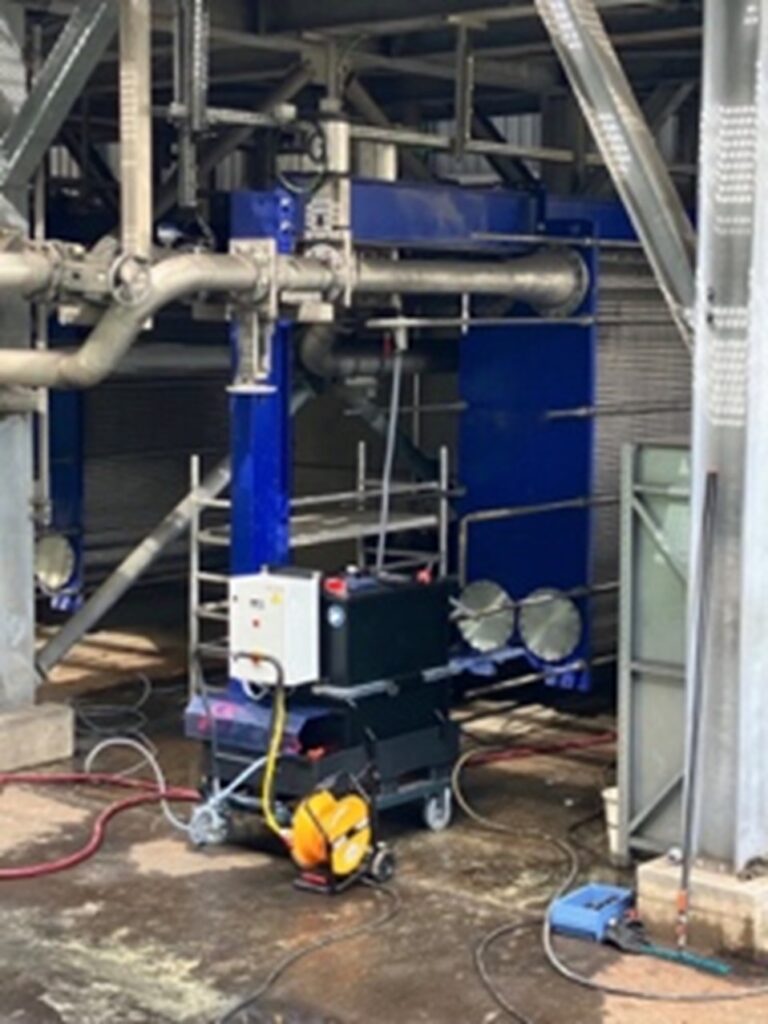
Hotter Care’s HeatFlow Pro is a heated chemical circulation cleaning solution designed for industrial use. It allows a heat exchanger to be cleaned by circulating a heated cleaning solution through the unit in a controlled way, without dismantling the equipment.
The method is suitable not only for heat exchangers, but also for oil coolers, process pipelines, tanks and other applications that require CIP cleaning. The essential point is that the cleaning can be carried out in a way that suits the process and uses the correct chemistry.
Heated circulation cleaning is particularly useful when the fouling is persistent, layered or cannot be removed effectively by simple flushing. Controlled temperature, flow and cleaning chemistry improve cleaning efficiency and make the result more predictable.

The right cleaning chemistry determines the result
Heat exchanger cleaning is not simply a matter of circulating any cleaning agent through the system. The result depends heavily on what the fouling consists of and how it reacts to the selected chemistry.
Organic deposits, fats and oils require a different approach than scale, rust or mineral deposits. Alkaline cleaning agents are typically suitable for greasy and organic fouling, while acidic cleaning agents are more effective against scale and mineral deposits.
If the chemistry is selected incorrectly, the cleaning result may remain incomplete. Part of the deposit may remain on the surfaces, pressure drop may not decrease as expected and heat transfer performance may not recover sufficiently. Successful cleaning therefore always begins with assessing the application and the type of fouling.

Case example: 50 percent performance improvement in two hours
At a paper mill, a 2.5 cubic metre plate heat exchanger was cleaned using heated chemical circulation cleaning. The cleaning took two hours, and the heat exchanger did not need to be dismantled.
After cleaning, heat transfer performance had improved by 50 percent.
The result illustrates why heat exchanger cleaning should not be seen merely as a maintenance task. When fouling restricts heat transfer, correctly timed cleaning can quickly restore a significant share of lost performance.
A clean heat exchanger improves energy efficiency and operational reliability
The benefits of heat exchanger cleaning are not limited to energy consumption. When heat transfer works as designed, the process can often be operated more steadily and with lower load. At the same time, pressure drop decreases and the need for pumping energy may be reduced.
A cleaner heat exchanger can affect production in several ways. It may restore heat transfer closer to the designed level, reduce pressure drop, improve process controllability and reduce the need for dismantling work or additional downtime.
The greatest benefit is achieved when cleaning is done proactively. If cleaning is postponed until the situation becomes critical, part of the potential benefit has already been lost.
When should the need for heat exchanger cleaning be assessed?
The need for cleaning should be assessed at the latest when the process shows changes that have no other clear explanation. A declining temperature difference, increasing pressure drop and rising energy consumption are signs that should be investigated early.
A sensible starting point is often to compare current performance with earlier operating data. If the same process now requires more energy, more pumping or longer operating time than before, the heat exchanger should be one of the first items to check.
Masspap helps assess the application, select the right cleaning method and define the suitable cleaning chemistry. Cleaning can be carried out by the customer using the HeatFlow Pro unit, or as a turnkey service when needed.
Summary: heat exchanger cleaning is part of energy efficiency management
A dirty heat exchanger is not just a maintenance issue. It is a question of energy efficiency, operational reliability and production profitability.
When heat transfer surfaces become fouled, the process may appear to continue normally, but energy consumption increases and performance declines. Correctly timed chemical circulation cleaning can restore heat transfer performance, reduce pressure drop and help avoid unnecessary energy costs.
If heat exchanger performance has declined, the issue should not be left until it becomes a production disturbance.
FAQ section
How do you know if a heat exchanger is fouled?
Fouling often appears as reduced heat transfer, increasing pressure drop, higher energy consumption or the inability of the process to reach the same temperatures as before. The problem can develop gradually, which is why comparison with earlier operating data is important.
Can a heat exchanger be cleaned without dismantling?
Yes. In many applications, chemical circulation cleaning allows the heat exchanger to be cleaned without dismantling. The cleaning solution is circulated through the unit in a controlled way, removing deposits from heat transfer surfaces without mechanical disassembly.
How often should a heat exchanger be cleaned?
The cleaning interval depends on the process, type of fouling, operating hours and energy cost. In some applications, a reasonable interval may be a few months; in others, it may be longer. The best way to define the interval is to monitor heat transfer performance, pressure drop and energy consumption.
Why is heated chemical circulation cleaning effective?
Heat improves the performance of many cleaning chemicals and accelerates the removal of deposits. When the cleaning solution circulates at a controlled flow rate, it can act evenly on the heat transfer surfaces. This makes the cleaning result more predictable compared with simple flushing.
Is heat exchanger cleaning an energy efficiency measure?
Often yes, if fouling is reducing heat transfer. Cleaning can restore process efficiency and reduce energy consumption, but the effect depends on the application, degree of fouling, operating hours and energy price. That is why the need for cleaning should be assessed using technical measurements and the actual process conditions.
Would you like to assess the performance and potential energy losses of your heat exchangers?
Our Product Manager, Aleksi Hämäläinen, can provide more information and carry out a free on-site audit (free on-site in Finland only).
Aleksi Hämäläinen
Product Manager
Tel. +358 40 529 8483
aleksi.hamalainen@masspap.fi